Memodyne Official Website › Ingredients
IngredientsMemodyne Ingredients: the six names and what each one is
Memodyne names six ingredients on its listing artwork: niacin, calcium as calcium carbonate, L-arginine, L-arginine AKG 2:1, L-citrulline HCl and L-citrulline malate. No amount is printed for any of them, so this page sets each name beside the amount its own published trials used, with the population and the measured outcome attached.
Four of the six are nitric-oxide chemistry. One is a B vitamin with a published upper limit. One is a mineral that the seller's own sales page leaves out.
The six names printed on the Memodyne artwork
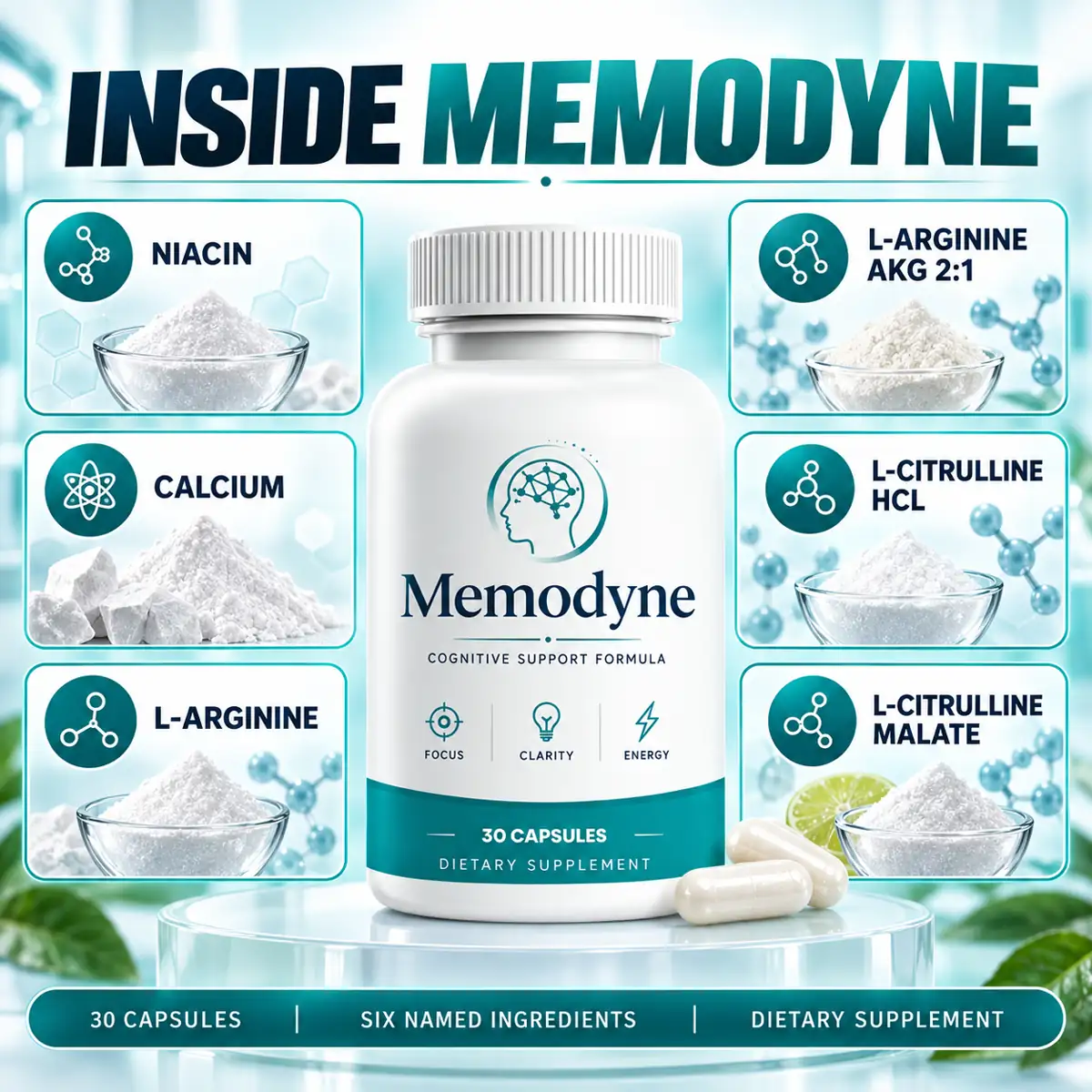
The listing graphic arranges six tiles around the bottle, one ingredient to a tile, each with a small molecular icon and a bowl of white powder. A strip along the bottom reads 30 CAPSULES, SIX NAMED INGREDIENTS, DIETARY SUPPLEMENT.
Count the molecules rather than the tiles and the number is four: arginine, citrulline, niacin and calcium. Arginine appears free and as the AKG salt; citrulline appears as the hydrochloride and as the malate.
| Printed name | Compound class | What a trial of it gave | Where that research comes from |
|---|---|---|---|
| Niacin | Vitamin B3 | 35 mg is the US tolerable upper intake level for supplemental nicotinic acid | Nutrition and lipid medicine |
| Calcium | Mineral, as calcium carbonate | Supplement trials in adults typically run 500 to 1,200 mg a day | Bone medicine, with one cognitive cohort study |
| L-Arginine | Amino acid, nitric oxide substrate | Oral studies run 3 to 6 g a day, split across doses | Vascular pharmacology |
| L-Arginine AKG 2:1 | Arginine bound to alpha-ketoglutarate | The one randomised human trial of the compound used 10 g a day | Sports nutrition |
| L-Citrulline HCl | Amino acid, arginine precursor | 3 g a day for 12 weeks, and 6 g a day in the shorter studies | Vascular pharmacology |
| L-Citrulline Malate | Citrulline bound to malic acid | 6 to 8 g taken once, or 6 g a day for six weeks | Exercise physiology |
The third column is the amount the published research used. It is not an amount claimed for this product.
Every Memodyne ingredient, one at a time
Each card carries the compound, the family it belongs to, the amount its published trials used, and what those trials actually measured.
Niacin
Vitamin B3Trials: the 35 mg US upper limit is the reference pointNiacin is a B vitamin with two supplement forms that behave very differently. Nicotinic acid opens skin capillaries and produces the flush that anyone who has taken a high-dose B complex will recognise. Nicotinamide does not flush and is used at higher amounts without it.
The number to hold is 35 mg a day, the US tolerable upper intake level for the supplemental nicotinic acid form. The meta-analysis that defined it pooled 47 studies covering 11,741 people and concluded that in healthy adults taking nicotinic acid alone, major adverse effects appeared below 1,000 mg a day, which is why its authors called the 35 mg limit conservative.
The frightening niacin headlines belong to a different product entirely. HPS2-THRIVE gave 2,000 mg a day of extended-release niacin with laropiprant to 25,673 patients and found excess new-onset diabetes, bleeding and infection. That is a lipid drug at roughly sixty times the upper intake level, not a vitamin in a capsule.
Niacin matters on this particular bottle for one reason: it is the only ingredient here whose meaningful amount is small enough to fit alongside five others. That makes the printed panel worth reading on arrival.
Calcium
Mineral, as calcium carbonateTrials: 500 to 1,200 mg a day in bone medicineCalcium carbonate is chalk. It is the calcium in an antacid tablet and in most bone-density supplements, and it is an unusual thing to find on a cognitive label at all.
It is also the one name on this artwork that the seller's own sales page leaves out, printing beta-alanine in its place. This desk follows the artwork, because the artwork is what will be on the container in your kitchen.
The honest note about calcium and cognition points away from the product rather than towards it. A seven-year longitudinal analysis in ageing women found that reported calcium supplement use tracked roughly threefold higher odds of cognitive decline (odds ratio 3.64, 95% confidence interval 1.47 to 9.01), with decline occurring in 26 per cent of participants overall. That is an observational association in a specific population at bone-medicine amounts, it is not evidence of harm from a capsule whose calcium content is unstated, and it is not a reason to panic. It is a reason not to pretend calcium is here for its cognitive record, because it does not have a good one.
The practical point is simpler. Anyone already taking calcium for bone density is getting several hundred milligrams a day, and calcium binds certain thyroid and antibiotic medicines in the gut. Read the printed panel before adding a second source. The NIH Office of Dietary Supplements calcium fact sheet sets out the intake reference ranges.
L-Arginine
Amino acid, nitric oxide substrateTrials: 3 to 6 g a day, split across dosesArginine is the raw material the body uses to make nitric oxide, the molecule that relaxes blood-vessel walls. On paper it is the obvious ingredient for any formula selling blood flow.
In practice, oral arginine has a problem that has been understood for two decades. The gut wall is rich in arginase, an enzyme that converts arginine to ornithine and urea before it ever reaches the bloodstream. A stable-isotope study in humans traced a labelled arginine meal and showed how much of it is routed to urea synthesis rather than to nitric oxide.
That first-pass loss is the whole reason citrulline appears on modern labels, and it is why a formula that names both is not simply doubling up. It is naming the substrate and naming the workaround.
A 2019 review of oral arginine and citrulline on blood pressure found measurable reductions in systolic and diastolic pressure from supplementation, which is the effect worth knowing about before stacking this with a blood-pressure medicine.
L-Arginine AKG 2:1
Arginine bound to alpha-ketoglutarateTrials: 10 g a day in the one randomised human studyArginine alpha-ketoglutarate pairs two arginine molecules with one of alpha-ketoglutarate, a Krebs-cycle intermediate. The 2:1 in the name is that ratio. It arrived through bodybuilding supplements in the 2000s on the theory that the AKG portion would spare arginine from breakdown.
The human evidence is thin and it is not about brains. The randomised trial on the PubMed record is a twelve-day study in forty adolescent track athletes that gave 10 g of arginine AKG a day alongside 7.5 g of a second ingredient and measured jump height. The supplement group did not lose countermovement jump height across a training block while the placebo group did.
Ten grams a day, in fifteen-year-old runners, measured on a jump mat. It is a real finding and it has nothing whatever to say about memory in a fifty-year-old, which is exactly why it is printed here rather than summarised as clinically studied.
L-Citrulline HCl
Amino acid, arginine precursorTrials: 3 g a day for 12 weeks, or 6 g a day for fourThis is the best-evidenced name on the bottle, and it is worth saying so plainly on a page that is otherwise cautious.
Citrulline is absorbed largely intact, bypasses the intestinal arginase that destroys oral arginine, and is converted to arginine in the kidney. A double-blind crossover trial in twenty healthy volunteers compared six dosing regimes of citrulline, arginine and placebo after a week of supplementation. Citrulline raised plasma arginine dose-dependently and more effectively than arginine did. At 3 g twice a day it lifted the arginine-to-ADMA ratio from 186 to 278 and raised urinary nitrate and cyclic GMP.
The same paper reports the limit honestly: no arm improved flow-mediated dilation over its own baseline, though across the pooled data the change in the arginine-to-ADMA ratio did correlate with the change in dilation.
Longer trials found more. A twelve-week randomised study of 3,000 mg a day in 66 adults around 63 improved flow-mediated dilation, but only in the participants whose blood pressure was high-normal at baseline, and a four-week trial of 6 g a day in adults around 62 improved dilation, arterial stiffness and fasting glucose.
Three grams a day is the low end of what worked. That is the figure to hold beside a single capsule shared with five other ingredients.
L-Citrulline Malate
Citrulline bound to malic acidTrials: 6 to 8 g in a single dose, or 6 g a day for six weeksCitrulline malate is citrulline paired with malic acid, another Krebs-cycle intermediate. It is the form sports nutrition standardised on, and the bodybuilding literature around it is large.
Whether the malate adds anything has now been tested directly. A randomised double-blind crossover trial in trained young adults set a single dose of plain L-citrulline against the same dose of citrulline malate on neuromuscular performance, and a six-week parallel trial did the same over a training block with blood biomarkers attached. Neither found the malate form superior.
For a cognitive product that already names citrulline HCl, the malate is therefore best read as a second source of the same amino acid rather than as a sixth distinct active. A review of citrulline and exercise performance reaches the same place from the sports side.
What one Memodyne capsule can physically hold
This is the arithmetic that decides how to read every claim on the carton, and it takes one paragraph.
A size 0 capsule, the common shape for this kind of product, holds roughly 500 mg to 800 mg of powder. Everything on the label has to fit inside that, along with whatever flow agent keeps the filling machine running. Now set the trial amounts against it: 3,000 mg of citrulline in the twelve-week study, 6,000 mg in the four-week one, 10,000 mg of arginine AKG in the only randomised human trial of that compound.
One capsule cannot carry a trial amount of any of the four amino-acid ingredients, and it is not close. That is not an accusation about this brand; it is true of every single-capsule amino-acid product on the shelf, and it is the reason this desk prints trial amounts in a column of their own instead of implying that the capsule matches them.
Niacin is the exception, and it is the whole reason the printed panel is worth reading. Thirty-five milligrams fits easily, several times over.
What to check on the Memodyne bottle when it arrives
Photograph the back panel
Federal labelling rules require a Supplement Facts panel on the container even where the marketing artwork carries none. Thirty seconds with a phone gives you the document this page cannot.
Compare the six names
Check the panel against the six above. The line to look at first is the sixth: calcium on the artwork, beta-alanine on the seller's page. Whichever the panel prints is the answer.
Read the niacin figure against 35 mg
It is the one number on the panel with a published reference point beside it. Anything at or below the upper intake level is ordinary; anything far above it is worth a conversation.
Check the lot against the listing
This listing is lot MEM-26/MA-2612. Verify a batch shows where the code is printed and what to do if it does not match.
The panel wins, and this desk wants to know. Send a photograph to [email protected] and the page is corrected with the review date moved. A correction is published rather than quietly applied.
Memodyne ingredient questions
How many ingredients does Memodyne have?
Six are named on the listing artwork: niacin, calcium as calcium carbonate, L-arginine, L-arginine AKG 2:1 extract, L-citrulline HCl and L-citrulline malate. Four of those six are two molecules counted twice, once free and once as a salt.
Does Memodyne contain a proprietary blend?
No blend name appears anywhere in the supplied material. The six names are given openly, which is better disclosure than most of this shelf offers, even though the amounts beside them are absent from the artwork.
Is there caffeine in Memodyne?
No stimulant is named on the artwork. The word Energy on the front band sits beside a lightning icon and describes the claim the seller is making, not an ingredient in the capsule.
Why does Memodyne name both L-citrulline HCl and L-citrulline malate?
They are the same amino acid paired with two different partners. The malate form is the one sports nutrition adopted, and the head-to-head trial found no measurable advantage from the malic acid over plain citrulline.
Does Memodyne contain beta-alanine?
The artwork does not name it; the seller's sales page does, in place of calcium. Two sources, one differing line. This desk follows the bottle, and the printed panel on the container you receive settles it.
How this Memodyne ingredient page was written
Every record below was pulled from the NCBI summary service in this build and checked for retraction twice.
- Minto C, Vecchio MG, Lamprecht M, Gregori D. Definition of a tolerable upper intake level of niacin: a systematic review and meta-analysis of the dose-dependent effects of nicotinamide and nicotinic acid supplementation. Nutr Rev. 2017;75(6):471-490. PMID 28541582. https://pubmed.ncbi.nlm.nih.gov/28541582/
- Haynes R, Valdes-Marquez E, Hopewell JC, Chen F, Li J, Parish S, Landray MJ, Armitage J; HPS2-THRIVE Collaborative Group. Serious adverse effects of extended-release niacin/laropiprant: results from the Heart Protection Study 2-Treatment of HDL to Reduce the Incidence of Vascular Events (HPS2-THRIVE) trial. Clin Ther. 2019;41(9):1767-1777. PMID 31447131. https://pubmed.ncbi.nlm.nih.gov/31447131/
- Rabec M, Bourgeais A, Gautier J, Corvaisier M, Brière O, Annweiler C. Association between calcium supplement use and cognitive impairment in ageing women: a longitudinal analysis. Australas J Ageing. 2026;45(2):e70186. PMID 42159347. https://pubmed.ncbi.nlm.nih.gov/42159347/
- National Institutes of Health, Office of Dietary Supplements. Calcium: fact sheet for health professionals. Bethesda, MD. https://ods.od.nih.gov/factsheets/Calcium-HealthProfessional/
- Mariotti F, Petzke KJ, Bonnet D, Szezepanski I, Bos C, Huneau JF, Fouillet H. Kinetics of the utilization of dietary arginine for nitric oxide and urea synthesis: insight into the arginine-nitric oxide metabolic system in humans. Am J Clin Nutr. 2013;97(5):972-9. PMID 23535108. https://pubmed.ncbi.nlm.nih.gov/23535108/
- Khalaf D, Krüger M, Wehland M, Infanger M, Grimm D. The effects of oral l-arginine and l-citrulline supplementation on blood pressure. Nutrients. 2019;11(7):1679. PMID 31336573. https://pubmed.ncbi.nlm.nih.gov/31336573/
- Kaczka P, Kubicka K, Batra A, Maciejczyk M, Kopera E, Bira J, Zając T. Effects of co-ingestion of β-hydroxy-β-methylbutyrate and L-arginine α-ketoglutarate on jump performance in young track and field athletes. Nutrients. 2021;13(4):1064. PMID 33805883. https://pubmed.ncbi.nlm.nih.gov/33805883/
- Schwedhelm E, Maas R, Freese R, Jung D, Lukacs Z, Jambrecina A, Spickler W, Schulze F, Böger RH. Pharmacokinetic and pharmacodynamic properties of oral L-citrulline and L-arginine: impact on nitric oxide metabolism. Br J Clin Pharmacol. 2008;65(1):51-9. PMID 17662090. https://pubmed.ncbi.nlm.nih.gov/17662090/
- Nogimura D, Nagaoka K, Ogino K, Ogino N, Moriyasu K, Morita M. Vascular effects of l-citrulline supplementation in healthy adults are largely influenced by the prehypertensive range of blood pressure: a double-blind, randomized, placebo-controlled, parallel-group study. Nutr Res. 2026;150:157-173. PMID 42142423. https://pubmed.ncbi.nlm.nih.gov/42142423/
- Kang Y, Dillon KN, Levitt DE, Figueroa A. Effects of L-citrulline supplementation on endothelial function, arterial stiffness, and blood glucose level in the fasted and acute hyperglycemic states in middle-aged and older adults with type 2 diabetes. Nutrients. 2025;17(23):3739. PMID 41374029. https://pubmed.ncbi.nlm.nih.gov/41374029/
- Gonzalez AM, Trexler ET. Effects of citrulline supplementation on exercise performance in humans: a review of the current literature. J Strength Cond Res. 2020;34(5):1480-1495. PMID 31977835. https://pubmed.ncbi.nlm.nih.gov/31977835/
- Martín-Olmedo JJ, Miras-Moreno S, Cuadra-Montes K, García-Ramos A, Ruiz JR, Jurado-Fasoli L. Malate or not? Acute effects of L-citrulline versus citrulline malate on neuromuscular performance in young, trained adults: a randomized, double-blind, placebo-controlled crossover trial. Int J Sport Nutr Exerc Metab. 2025;35(2):89-98. PMID 39662304. https://pubmed.ncbi.nlm.nih.gov/39662304/
- Bayat D, Azizi M, Behpour N, Tinsley GM. Changes in resistance training performance, rating of perceived exertion, and blood biomarkers after six weeks of supplementation with L-citrulline vs. L-citrulline DL-malate. J Int Soc Sports Nutr. 2025;22(1):2513944. PMID 40470618. https://pubmed.ncbi.nlm.nih.gov/40470618/
Six names, six trial amounts, one Memodyne bottle
Nothing on this page is a reason to buy or not to buy on its own. It is the information a reader needs to decide, and the window is what carries the risk while they do.
Two bottles $158 · six bottles $294 · 60-day money-back guarantee
Order Memodyne From This DeskLot MEM-26/MA-2612 · one capsule a day, 30 to a bottle · ships from the United States