Memodyne Official Website › Benefits
BenefitsWhat Are The Benefits Of Memodyne? The five supports the label prints
The seller prints five structure and function statements for Memodyne, covering memory, cognitive health, oxidative stress, mental clarity, neural communication, focus and neurotransmitter production. They are claims about support rather than treatment, and they are the ceiling for everything this website is permitted to say.
This page prints all five as the seller writes them, then says what each one is and is not allowed to mean.
The five Memodyne supports, quoted as the seller prints them
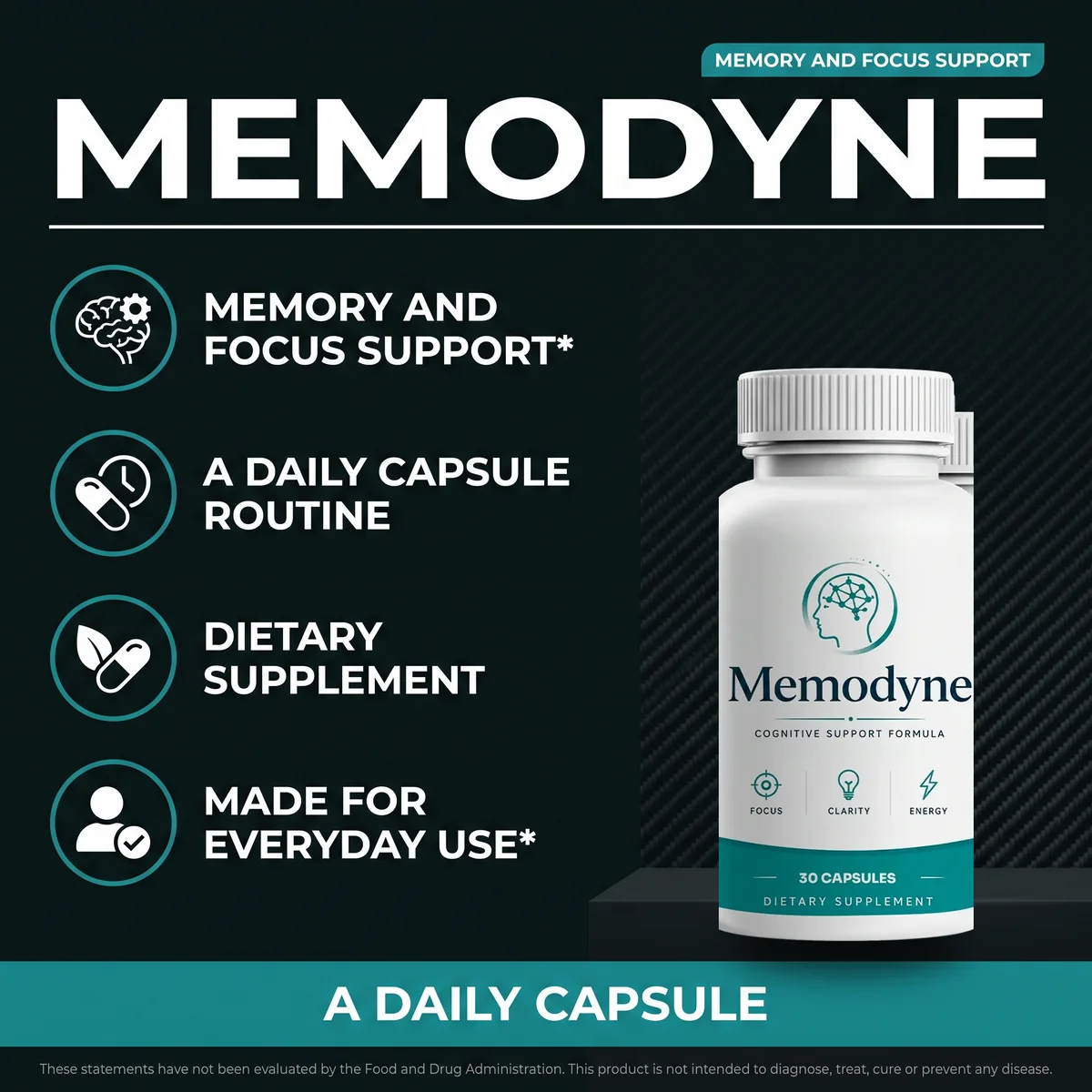
- Enhance memory function and support overall cognitive health
- Protect the brain from oxidative stress and improve mental clarity
- Boost neural communication and promote better brain performance
- Support long-term brain health and improve focus and concentration
- Optimize neurotransmitter production and contribute to a sharper, more agile mind
Those five sentences are the whole of the claim. There is nothing further in the supplied material, no clinical-study language, and no before-and-after figure attached to any of them.
What a structure and function claim means on a Memodyne label
The category of claim matters more than most buyers realise, and it is worth five minutes.
US law lets a dietary supplement describe how an ingredient affects a structure or a function of the body. A supplement may say it supports cognitive health. It may not say it treats cognitive decline, prevents dementia or improves a diagnosed condition, because those are disease claims and a product making them is a drug.
That is why every sentence in the list above uses support, boost, optimise, protect or contribute. The verbs are doing legal work. None of them requires a trial of the finished product, none of them is reviewed by the FDA before it is printed, and the disclaimer at the foot of every page on this site is the law's way of saying so.
None of that makes the claims dishonest. It makes them a different kind of statement from the one a reader may assume. The FDA's own guide to the claims a supplement label may make is the clearest short explanation of the difference.
| The seller's word | What it is allowed to mean | What it is not allowed to mean |
|---|---|---|
| Enhance memory function | An ingredient acts on a normal bodily function. | It restores memory that has been lost. |
| Protect the brain from oxidative stress | An ingredient participates in antioxidant chemistry. | It prevents a neurodegenerative disease. |
| Boost neural communication | An ingredient acts on normal signalling. | It repairs damaged signalling. |
| Support long-term brain health | It contributes to the maintenance of a normal function. | It reduces the risk of dementia. |
| Optimize neurotransmitter production | An ingredient is involved in a normal synthetic pathway. | It corrects a neurotransmitter deficit. |
The right-hand column is a list of things this website does not claim and is not permitted to claim.
The three Memodyne benefits with the most behind them
A vascular route with real evidence
Citrulline is the best-evidenced name here. Three grams a day for twelve weeks improved flow-mediated dilation in adults with high-normal blood pressure, and six grams a day for four weeks moved dilation, arterial stiffness and fasting glucose in adults around 62.
A once-daily routine that people keep
Six of the eight reviewers the distributor publishes bought three or six bottles, and the ones who liked it named the daily capsule itself as the reason. A habit that survives is the precondition for anything else.
Open disclosure of the names
Six ingredients are named rather than hidden behind a blend title. For a shelf where proprietary blends are the norm, naming the compounds is a real and checkable advantage.
How a Memodyne benefit claim compares with the category around it
A claim is easier to judge beside its neighbours than on its own, so it is worth setting these five against what the rest of this shelf prints.
Three things about this label stand out as better than the category average. It names its ingredients rather than hiding them behind a blend title. It does not print a clinically proven line anywhere, which a surprising number of products in this category do without a trial to support it. And it does not invent a named medical reviewer, which is the commonest trust device on this shelf and the emptiest.
Two things are worse than they could be. The marketing artwork carries no amounts, so the claims cannot be weighed against any trial without first buying the product and reading the container. And the five supports are written at a level of generality that covers almost any cognitive outcome a reader might hope for, which is legally safe and informationally thin.
The net position is a label that is honest about what it contains and vague about how much, which is a more defensible place to be than the reverse.
| Common on this shelf | On this label |
|---|---|
| A proprietary blend title hiding the list | Six ingredients named openly |
| "Clinically proven" with no trial of the product | No such claim appears |
| A named medical reviewer with a stock photograph | No clinician is named anywhere |
| Amounts printed beside each name | No amounts in the marketing artwork |
| A specific, checkable claim | Five general structure and function statements |
| A single-unit trial purchase | No single bottle; two is the entry point |
Three rows favour this product and three do not, which is roughly where an honest comparison usually lands.
What Memodyne does not do, said plainly
A benefits page that only lists benefits is an advertisement. Four things belong here.
It is not a treatment. Not for memory loss, not for mild cognitive impairment, not for dementia or Alzheimer's disease. Memory that is changing in a way other people have noticed is a reason to be assessed.
It does not carry a trial of its own. No study of this product, or of this combination of six ingredients, exists anywhere. Every citation on this website is a study of one ingredient at a stated amount.
It does not publish amounts in its artwork. The container carries a printed panel; the marketing material a buyer sees beforehand does not reproduce it.
It is not a substitute for the things that do have randomised evidence for cognitive outcomes. Hearing treatment, blood-pressure treatment, exercise and sleep all have it, and none of the four is sold here.
These statements have not been evaluated by the Food and Drug Administration. This product is not intended to diagnose, treat, cure or prevent any disease. It is a dietary supplement, it is not a drug, and it is not FDA-approved.
How this Memodyne benefits page was written
- Nogimura D, Nagaoka K, Ogino K, Ogino N, Moriyasu K, Morita M. Vascular effects of l-citrulline supplementation in healthy adults are largely influenced by the prehypertensive range of blood pressure: a double-blind, randomized, placebo-controlled, parallel-group study. Nutr Res. 2026;150:157-173. PMID 42142423. https://pubmed.ncbi.nlm.nih.gov/42142423/
- Kang Y, Dillon KN, Levitt DE, Figueroa A. Effects of L-citrulline supplementation on endothelial function, arterial stiffness, and blood glucose level in the fasted and acute hyperglycemic states in middle-aged and older adults with type 2 diabetes. Nutrients. 2025;17(23):3739. PMID 41374029. https://pubmed.ncbi.nlm.nih.gov/41374029/
- US Food and Drug Administration. Label claims for conventional foods and dietary supplements. Silver Spring, MD. https://www.fda.gov/food/nutrition-food-labeling-and-critical-foods/label-claims-conventional-foods-and-dietary-supplements
- National Center for Complementary and Integrative Health. Dietary supplements and cognitive function, dementia, and Alzheimer's disease: what the science says. Bethesda, MD. https://www.nccih.nih.gov/health/providers/digest/dietary-supplements-and-cognitive-function-dementia-and-alzheimers-disease-science
- Livingston G, Huntley J, Liu KY, Costafreda SG, Selbæk G, Alladi S, et al. Dementia prevention, intervention, and care: 2024 report of the Lancet standing Commission. Lancet. 2024;404(10452):572-628. PMID 39096926. https://pubmed.ncbi.nlm.nih.gov/39096926/
- Vyas CM, Manson JE, Sesso HD, Cook NR, Rist PM, Weinberg A, et al. Effect of multivitamin-mineral supplementation versus placebo on cognitive function: results from the clinic subcohort of the COcoa Supplement and Multivitamin Outcomes Study (COSMOS) randomized clinical trial and meta-analysis of 3 cognitive studies within COSMOS. Am J Clin Nutr. 2024;119(3):692-701. PMID 38244989. https://pubmed.ncbi.nlm.nih.gov/38244989/
The Memodyne claims ceiling, in plain sight before you pay
Five supports, printed as the seller writes them, with the limit of each one stated beside it. A reader who buys on those terms is buying something they can actually check.
Two bottles $158 · six bottles $294 · 60-day money-back guarantee
Order Memodyne From This DeskLot MEM-26/MA-2612 · one capsule a day, 30 to a bottle · ships from the United States