Memodyne Official Website › Blog
From the reading roomWhat Actually Helps Memory In The Published Evidence
Four interventions carry randomised evidence for cognitive outcomes in adults. None of them is a supplement, all four are more modest than their headlines, and a reader deciding how to spend money deserves the numbers rather than the slogan.
A website that sells a memory supplement has an obvious incentive not to write this article. It is being written anyway, because a reader deciding what to do about a small, repeated irritation deserves to know what the strongest evidence in the field actually supports before deciding what to buy.
The short version: four things carry randomised evidence for cognitive outcomes in adults, none of them comes in a bottle, and all four are considerably more hedged than the headlines about them.
The fourteen risk factors
The 2024 report of the Lancet standing Commission on dementia is the most complete synthesis in the field. It identifies fourteen modifiable risk factors across a life course.
They are, in the Commission's own grouping: low education in early life; hearing loss, high LDL cholesterol, depression, head injury, physical inactivity, diabetes, smoking, hypertension, obesity and excessive alcohol in midlife; and social isolation, air pollution and untreated vision loss in later life.
No supplement appears on that list. That absence is not an oversight and it is not a bias against the category; it reflects what the randomised evidence supports. It is the single most useful fact a reader of a supplement website can hold.
Hearing: the trial that found nothing, and where it did
Hearing loss is the largest single modifiable risk factor the Commission identifies, which makes the randomised test of treating it the most important trial in this area. It is also more complicated than the coverage suggested.
ACHIEVE randomised 977 adults aged 70 to 84 with untreated hearing loss to either a hearing intervention or a health-education control, across four US sites. The cohort had a mean age of 76.8, and 54 per cent were women. Participants came from two sources: an existing cardiovascular cohort study called ARIC, who were older and carried more risk factors, and a larger group recruited specifically for the trial.
Across the whole cohort, the hearing intervention did not reduce three-year cognitive decline. The trial's own interpretation says so directly. The benefit appeared in the higher-risk ARIC subgroup, which the authors describe as suggesting that a hearing intervention might reduce cognitive change in populations at increased risk.
That is a hedged result from the best-designed trial of the best-supported risk factor in the field, and it is still stronger than anything any supplement on this shelf can offer.
Blood pressure: a hazard ratio that crossed one
Hypertension is the second big lever, and the long-term cognitive follow-up of the SPRINT trial is the evidence.
That follow-up re-contacted 7,221 of 9,361 randomised participants and ascertained cognitive status for 4,232 of them, with a mean age of 67. It accrued 216 new cases of probable dementia. The intensive blood-pressure group recorded probable dementia at 8.5 per 1,000 person-years against 10.2 in the standard group, a hazard ratio of 0.86 with a 95 per cent confidence interval from 0.72 to 1.02.
That interval crosses one, which means the result for probable dementia alone did not reach conventional statistical significance. Mild cognitive impairment came in at a hazard ratio of 0.87 and the composite of the two at 0.89, both consistent with the trial's earlier findings.
| Outcome | Intensive | Standard | Hazard ratio |
|---|---|---|---|
| Probable dementia | 8.5 per 1,000 person-years | 10.2 per 1,000 person-years | 0.86 (0.72 to 1.02) |
| Mild cognitive impairment | Lower | Higher | 0.87 (0.76 to 1.00) |
| The composite of both | Lower | Higher | 0.89 |
Read the intervals rather than the point estimates. This is what the strongest evidence in the field looks like when it is printed honestly.
The practical reading is that controlling blood pressure is worth doing for many reasons and probably helps cognition modestly. The practical reading is not that it is a proven cognitive treatment, and anybody presenting it that way is overstating the best trial in the area.
Exercise and sleep
Physical inactivity is on the Commission's list, and the exercise literature is large enough that the useful question has moved from whether to which kind. A Bayesian model-based network meta-analysis set out to answer exactly that for executive function in older adults, comparing types and doses of exercise across randomised trials.
Sleep is the fourth, and it is the one most people can act on tonight. It does not appear on the Commission's fourteen as a separate line, but the relationship between sleep and memory consolidation is one of the better-established findings in cognitive neuroscience, and it is the thing most likely to be producing the symptom that sent somebody looking at supplement listings in the first place.
There is an uncomfortable implication in that last sentence, and it is worth being direct about it. A reader who is sleeping six hours a night and buys a capsule has bought something that will not address what is actually happening.
- Hearing: the largest single modifiable risk factor the Commission names.
- Blood pressure: the best-powered randomised cognitive trial in the field.
- Exercise: a large literature and a network meta-analysis comparing types and doses.
- Sleep: the fastest to act on and the cheapest of the four.
- None of the four is sold on this website.
Where supplements sit in this picture
The largest randomised test of a supplement for cognition is worth knowing about, because it is the strongest thing the category has and it is still modest.
COSMOS-Mind tested a daily multivitamin against placebo for cognitive function in older adults, and a pooled analysis of the cognitive studies within COSMOS followed. Both found a benefit, and both sets of authors were careful to say that replication was needed before anything was recommended.
That is the ceiling for the whole supplement category, and it is for a multivitamin rather than for anything on the shelf this website sells from. Formulas built on amino acids, botanicals or nitric-oxide chemistry have nothing of comparable size behind them for a cognitive endpoint, and this one has no trial of its own at all.
A supplement in this category is a plausible daily habit with a mechanism behind it. It is not a cognitive intervention with randomised evidence, and it should not be bought instead of the four things that are.
Why the hedges matter more than the headlines
Both of the big trials above are usually reported as successes, and both of them are hedged in their own papers. It is worth pausing on why that gap exists, because it is the single best defence a reader has against every claim in this category.
A trial reports an effect size and an interval around it. The point estimate is the headline; the interval is the honest statement of how much the result could plausibly differ from it. SPRINT's hazard ratio for probable dementia was 0.86, which sounds like a fourteen per cent reduction. Its interval ran from 0.72 to 1.02, which includes no effect at all. Both of those sentences describe the same result and only one of them usually survives into a summary.
ACHIEVE has the same shape in a different form. The headline in much of the coverage was that hearing aids protect cognition. The trial's own interpretation is that the intervention did not reduce three-year cognitive decline in the whole cohort, and that a benefit appeared in the higher-risk subgroup. A subgroup finding in a trial that missed its primary endpoint is a hypothesis worth testing again, not a conclusion.
Once a reader is in the habit of asking for the interval and for the primary endpoint, marketing copy in this category becomes much easier to evaluate. Almost none of it reports either, and a claim built on an ingredient whose trial measured an artery in a forearm can be placed correctly in about a minute.
What was the primary endpoint, and did the trial hit it? And what was the confidence interval, rather than the point estimate? Both are in the abstract, and both are free to look up.
A sensible order to spend money in
This is the part that matters, and it is a list rather than an argument.
Get hearing checked, because it is the largest single modifiable factor on the Commission's list and because treating it is a one-off cost that pays back across everything else in a life. Get blood pressure measured and treated if it needs it, because the SPRINT follow-up is the best-powered evidence in this field and because the treatment is cheap and well understood.
Fix sleep before buying anything, because it is free and because it is the likeliest explanation for a symptom that arrived recently. Move regularly, in whatever form is sustainable. And then, if a daily capsule with a plausible mechanism and a sixty-day money-back window is still wanted, buy one with the expectations set by everything above.
Because a reader who buys a capsule instead of getting their hearing checked has been badly served, and because a page that only lists reasons to buy is not information. These statements have not been evaluated by the Food and Drug Administration.
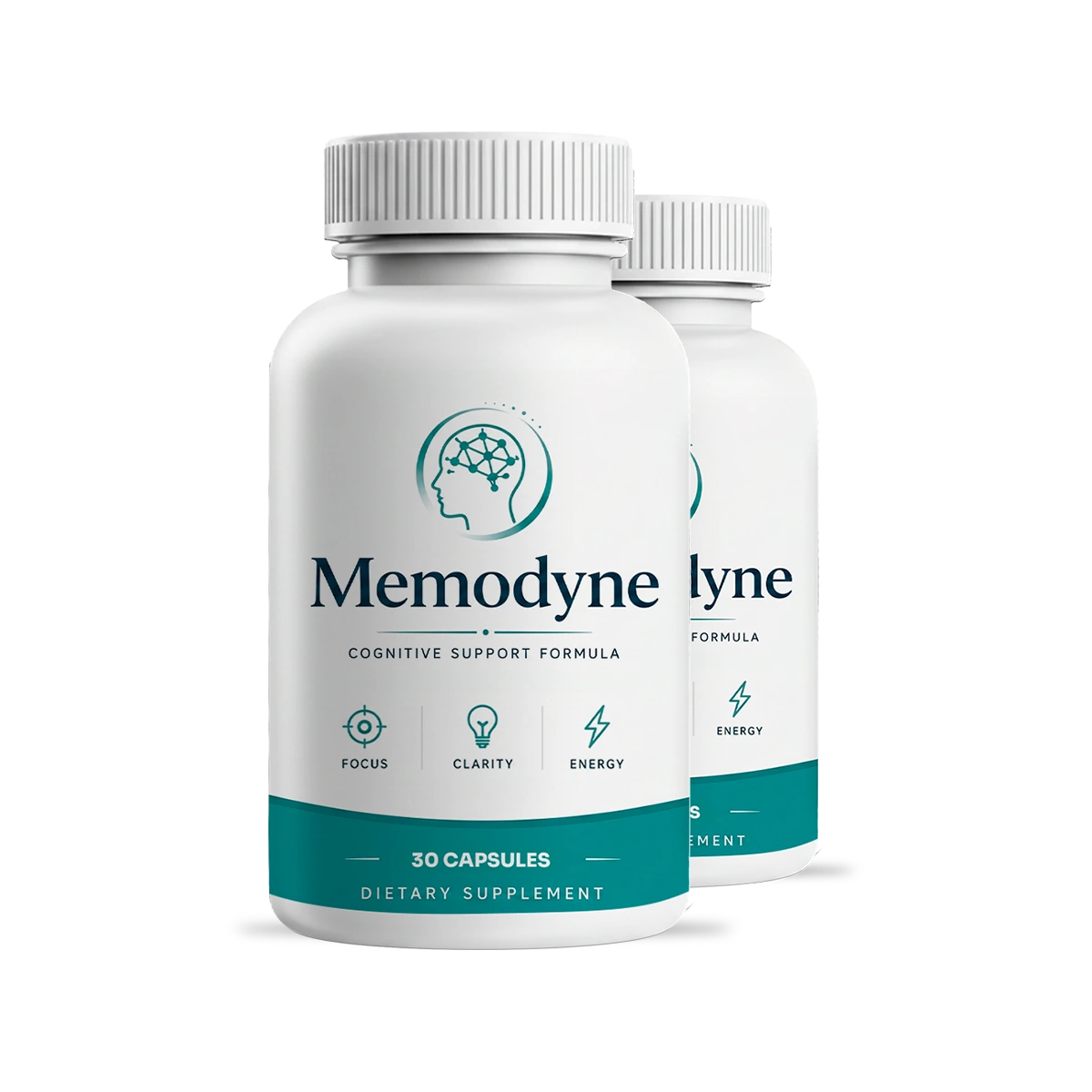
Take Memodyne after the four things above, not instead of them
A once-daily capsule with a real mechanism, an honest account of where it sits in the evidence, and sixty days from purchase to decide whether it earns its place.
Two bottles $158 · six bottles $294 · 60-day money-back guarantee
Order Memodyne From This DeskLot MEM-26/MA-2612 · one capsule a day, 30 to a bottle · ships from the United States
- Livingston G, Huntley J, Liu KY, Costafreda SG, Selbæk G, Alladi S, et al. Dementia prevention, intervention, and care: 2024 report of the Lancet standing Commission. Lancet. 2024;404(10452):572-628. PMID 39096926. https://pubmed.ncbi.nlm.nih.gov/39096926/
- Lin FR, Pike JR, Albert MS, Arnold M, Burgard S, Chisolm T, et al. Hearing intervention versus health education control to reduce cognitive decline in older adults with hearing loss in the USA (ACHIEVE): a multicentre, randomised controlled trial. Lancet. 2023;402(10404):786-797. PMID 37478886. https://pubmed.ncbi.nlm.nih.gov/37478886/
- Reboussin DM, Gaussoin SA, Pajewski NM, Jaeger BC, Sachs B, Rapp SR, et al. Long-term effect of intensive vs standard blood pressure control on mild cognitive impairment and probable dementia in SPRINT. Neurology. 2025;104(3):e213334. PMID 39819096. https://pubmed.ncbi.nlm.nih.gov/39819096/
- Quan J, Zhu L, Chen Z, Chen Z, Li B, Yu S. Optimal type and dose of exercise for improving executive functions in older adults: a systematic review and Bayesian model-based network meta-analysis of RCTs. BMC Geriatr. 2026;26(1):64. PMID 42260365. https://pubmed.ncbi.nlm.nih.gov/42260365/
- Baker LD, Manson JE, Rapp SR, Sesso HD, Gaussoin SA, Shumaker SA, Espeland MA. Effects of cocoa extract and a multivitamin on cognitive function: a randomized clinical trial. Alzheimers Dement. 2023;19(4):1308-1319. PMID 36102337. https://pubmed.ncbi.nlm.nih.gov/36102337/
- Vyas CM, Manson JE, Sesso HD, Cook NR, Rist PM, Weinberg A, et al. Effect of multivitamin-mineral supplementation versus placebo on cognitive function: results from the clinic subcohort of the COcoa Supplement and Multivitamin Outcomes Study (COSMOS) randomized clinical trial and meta-analysis of 3 cognitive studies within COSMOS. Am J Clin Nutr. 2024;119(3):692-701. PMID 38244989. https://pubmed.ncbi.nlm.nih.gov/38244989/
- National Center for Complementary and Integrative Health. Dietary supplements and cognitive function, dementia, and Alzheimer's disease: what the science says. Bethesda, MD. https://www.nccih.nih.gov/health/providers/digest/dietary-supplements-and-cognitive-function-dementia-and-alzheimers-disease-science