Memodyne Official Website › Blog
From the reading roomA Supplement Label With No Numbers On It
Six names and not a single milligram. That is not unusual in this category, it is not necessarily sinister, and there is a specific thing a buyer can do about it that takes about thirty seconds.
There is a particular frustration in reading a supplement listing carefully, finding six ingredients named clearly and openly, and then realising that not one of them has an amount beside it.
This article is about that situation. It is common, it has a mundane explanation, it has a real consequence for a buyer, and there is something specific worth doing about it rather than either ignoring it or treating it as proof of bad faith.
What is actually missing, and what is not
Precision matters here, because the two things get conflated.
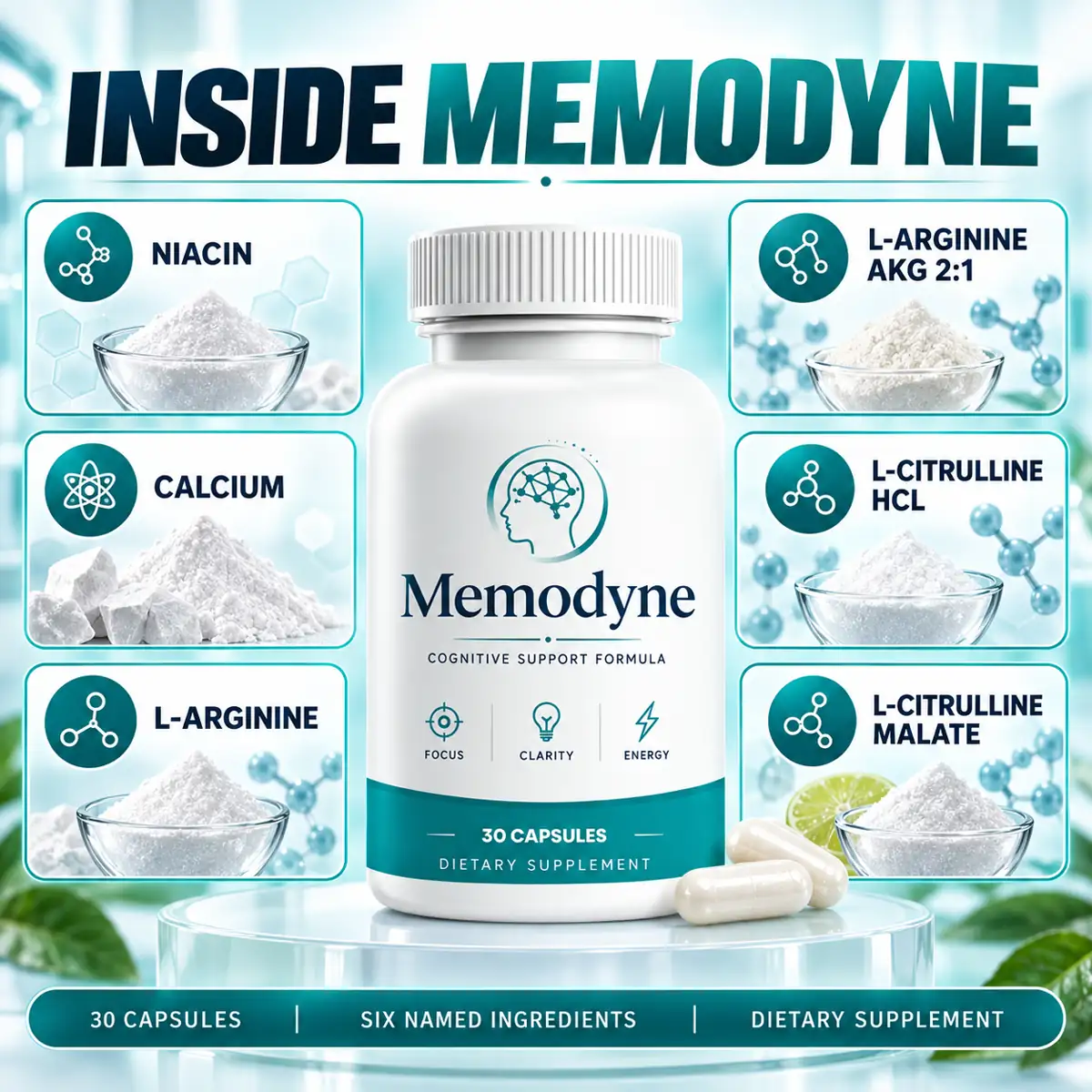
What is missing is a Supplement Facts panel in the marketing artwork. The material a buyer sees before purchasing on a listing like this one runs to a front-of-bottle shot, an ingredient graphic, several listing scenes and a wall of compliance seals. A panel with serving sizes and milligram figures is not among them.
What is not missing is the panel itself. Federal labelling rules require a Supplement Facts panel on the container of a dietary supplement sold in the United States. The bottle that arrives will carry one. So the situation is not that no amounts exist; it is that they are not visible until after the money has changed hands.
- The ingredient names are disclosed openly, with no blend title hiding them.
- The serving size is stated in the directions line: one capsule daily.
- The count is printed on the front of the bottle: thirty capsules.
- The amounts per serving appear on the container rather than in the artwork.
- Nothing on this website estimates an amount that is not printed.
Why marketing artwork prints names without numbers
There are three explanations and they are not mutually exclusive.
The first is production. Marketing artwork is built by a design team from a brief, often before the final formulation is locked, and a panel is a regulated document that has to be reproduced exactly. It is easier to photograph the front of a bottle than to typeset a panel that will have to be reissued if a single figure changes.
The second is commercial. A formula whose amounts are modest relative to the published trials reads better as a list of names than as a column of figures. That is an uncomfortable thing to write on a page that sells the product, and it would be dishonest to leave it out.
The third is that the category has drifted. Once one listing in a search result omits the panel, the listings that include it look cluttered by comparison, and the convention settles at the lower standard. None of the three explanations is an excuse, and a buyer does not need to decide between them in order to act.
What the panel on the container is for
A Supplement Facts panel is a standardised table, and its shape is worth knowing because it makes the thirty-second check easy.
It states the serving size and the servings per container at the top. Then it lists each dietary ingredient with the amount per serving and, where one has been established, the percent Daily Value. Ingredients without a Daily Value carry a dagger pointing at a footnote. Below the table sits an other-ingredients line, which is where the capsule shell, the flow agents and the fillers are declared.
Two lines on that panel do most of the work. The serving size, because an amount per serving means nothing without it. And the other-ingredients line, because it is where a vegetarian claim or an allergen question is actually settled.
What a capsule can physically hold
This is the arithmetic that makes the missing amounts matter, and it takes one paragraph.
A size 0 capsule, the common shape for a product like this, holds roughly 500 to 800 milligrams of powder in total. Everything on the label shares that space, along with whatever flow agent keeps a filling machine running. Now set the published trial amounts beside it: three thousand milligrams of citrulline in the twelve-week study, six thousand in the four-week one, ten thousand of arginine alpha-ketoglutarate in the only randomised human trial of that compound.
| Ingredient family | Amount its trials used | What a capsule holds |
|---|---|---|
| Citrulline | 3,000 to 6,000 mg a day | The whole capsule is 500 to 800 mg of everything |
| Arginine | 3,000 to 6,000 mg a day | The same |
| Arginine AKG | 10,000 mg a day in the one human trial | The same |
| Niacin | 35 mg is the US upper intake level | Fits comfortably, several times over |
| Calcium | 500 to 1,200 mg a day in bone trials | Would fill most of the capsule on its own |
This is arithmetic about capsules rather than an accusation about any brand. It is true of every single-capsule amino-acid product sold.
So a buyer looking at six names on a capsule label already knows something useful before reading the panel at all: the amino acids cannot be at trial amounts, because the capsule is not big enough. What the panel adds is precision, and one figure in particular.
The one number worth checking when it arrives
Niacin. It is the only ingredient on a label like this one whose meaningful amount is small enough that a capsule can carry it comfortably, which makes it the only figure on the panel a buyer can genuinely evaluate.
The reference point is 35 milligrams a day, the United States tolerable upper intake level for supplemental nicotinic acid. The meta-analysis behind that figure pooled 47 studies covering 11,741 people, and its own authors described the limit as conservative, noting that in healthy adults taking nicotinic acid alone the major adverse effects appeared below 1,000 milligrams a day.
So the check is simple. Find the niacin line on the panel. At or below 35 milligrams, it is an ordinary vitamin amount. Considerably above it, expect flushing and treat the figure as worth a conversation. This one line tells a buyer more about a manufacturer's judgement than the other five put together.
Photograph the back panel while the box is still open, before the label gets scuffed and before the bottle disappears into a cupboard. It is the only document in the transaction that carries amounts.
The line most people skip
Under the table on every Supplement Facts panel sits a line beginning Other Ingredients. It is set in smaller type, it is not part of the regulated table above it, and it is the line that settles most of the practical questions a buyer actually has.
It is where the capsule shell is declared, which is what decides whether a vegetarian mark on the front of a carton is accurate. Gelatin is an animal product; hypromellose, also called HPMC, is not. A vegetarian seal on the front and gelatin on the back is a contradiction that a buyer can spot in five seconds, and it is the sort of thing that does occasionally happen when artwork and formulation are produced by different teams.
It is also where the flow agents and the bulking agents are listed: magnesium stearate, silicon dioxide, rice flour, microcrystalline cellulose. None of those is alarming and all of them take up room in the capsule, which matters on a label whose active ingredients are measured in grams in the published literature.
And it is where allergens are declared. Anyone avoiding a particular ingredient for a medical reason should read that line before the table above it, because the table lists what a manufacturer is selling and the other-ingredients line lists everything else that is in the capsule.
- The capsule shell: gelatin, or a plant-derived alternative such as hypromellose.
- Flow agents and bulking agents, which share the capsule's fixed volume.
- Colourings, where any are used.
- Allergen statements, which usually sit immediately beneath it.
- Anything a front-of-carton claim depends on, including a vegetarian mark.
What a better label would print
None of what follows requires a new trial, a new ingredient or a bigger budget. It is disclosure, and disclosure is cheap.
It would reproduce the Supplement Facts panel in the listing artwork, so a buyer could read the amounts before paying rather than after. It would state the specific salt or form of each compound, because citrulline malate and citrulline HCl are not interchangeable by weight. It would publish a certificate of analysis from a named laboratory, dated and tied to a lot code, which is the one document that would actually verify what is in a bottle. And it would offer a single unit, so a first purchase costs a month instead of two.
Analytical work on supplement labelling has repeatedly found products whose content differs from what the label declares, which is exactly why the published assay is the strongest signal on that list and also the rarest. One such analysis is cited below.
An absent panel in marketing artwork is a disclosure problem, not evidence that a product is mislabelled or unsafe. The container carries a panel, and the way to settle any of this is to read it.
Read the panel on a Memodyne bottle rather than the artwork
The artwork names six ingredients and the container carries the figures. Photograph it on arrival and the comparison this article describes takes under a minute.
Two bottles $158 · six bottles $294 · 60-day money-back guarantee
Order Memodyne From This DeskLot MEM-26/MA-2612 · one capsule a day, 30 to a bottle · ships from the United States
- Minto C, Vecchio MG, Lamprecht M, Gregori D. Definition of a tolerable upper intake level of niacin: a systematic review and meta-analysis of the dose-dependent effects of nicotinamide and nicotinic acid supplementation. Nutr Rev. 2017;75(6):471-490. PMID 28541582. https://pubmed.ncbi.nlm.nih.gov/28541582/
- Ambrosio G, Wirth D, Joseph JF, Mazzarino M, de la Torre X, Botrè F, Parr MK. How reliable is dietary supplement labelling? Experiences from the analysis of ecdysterone supplements. J Pharm Biomed Anal. 2020;177:112877. PMID 31568967. https://pubmed.ncbi.nlm.nih.gov/31568967/
- US Food and Drug Administration. Label claims for conventional foods and dietary supplements. Silver Spring, MD. https://www.fda.gov/food/nutrition-food-labeling-and-critical-foods/label-claims-conventional-foods-and-dietary-supplements
- Nogimura D, Nagaoka K, Ogino K, Ogino N, Moriyasu K, Morita M. Vascular effects of l-citrulline supplementation in healthy adults are largely influenced by the prehypertensive range of blood pressure: a double-blind, randomized, placebo-controlled, parallel-group study. Nutr Res. 2026;150:157-173. PMID 42142423. https://pubmed.ncbi.nlm.nih.gov/42142423/
- Kang Y, Dillon KN, Levitt DE, Figueroa A. Effects of L-citrulline supplementation on endothelial function, arterial stiffness, and blood glucose level in the fasted and acute hyperglycemic states in middle-aged and older adults with type 2 diabetes. Nutrients. 2025;17(23):3739. PMID 41374029. https://pubmed.ncbi.nlm.nih.gov/41374029/
- Kaczka P, Kubicka K, Batra A, Maciejczyk M, Kopera E, Bira J, Zając T. Effects of co-ingestion of β-hydroxy-β-methylbutyrate and L-arginine α-ketoglutarate on jump performance in young track and field athletes. Nutrients. 2021;13(4):1064. PMID 33805883. https://pubmed.ncbi.nlm.nih.gov/33805883/
- National Institutes of Health, Office of Dietary Supplements. Calcium: fact sheet for health professionals. Bethesda, MD. https://ods.od.nih.gov/factsheets/Calcium-HealthProfessional/